How to Get More Google Reviews for Your Business
Posted on
- 18 May 2026
Simple Guide on Getting More Google Reviews For Your Business
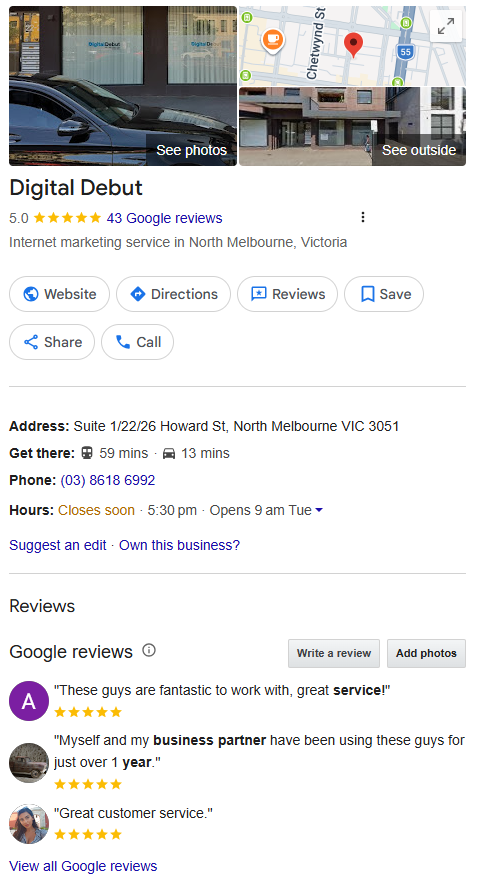
Twelve reviews. That is what the business down the road from you has. You have 87, with a 4.8 average, the most recent one posted three days ago. Who gets the call? You do. Every time.
Google reviews are not a vanity metric anymore. For local Australian businesses, they are one of the most tangible competitive advantages you can build, and one of the most neglected. Most business owners know they should be getting more reviews. Very few have a system that actually makes it happen.
This post is about fixing that.
Table of Contents
What Google Reviews Actually Do for Your Business
Two things. They help you rank, and they help you convert.
On the ranking side: Google’s local algorithm factors in your review count, your average star rating, the recency of your reviews, and whether you are responding to them. A consistent flow of genuine, recent reviews signals to Google that your business is active and trusted. That translates into better visibility in the Local Pack and Google Maps results.
On the conversion side: 88% of Australian consumers say they trust online reviews as much as a personal recommendation. When someone finds your business through a Google search, your review profile is usually the first thing they check. That moment — before they visit your website, before they call, before they do anything — is where your reviews either earn or lose their trust.
46% of Google searches have local intent. Around a third of those lead to a purchase within 24 hours. Your review count and rating sit right in the middle of that decision.
If you want the full picture of how reviews interact with everything else in local search, our post on how to rank on Google Maps is worth reading first.
Before You Ask Anyone for a Review, Do This
Your current SEO company probably hasn’t told you, but sort your Google Business Profile, seriously! An incomplete or unverified profile undermines everything else you do. If customers land on your GBP (Google Business Profile) and find outdated hours, two photos, and a vague description, the review you worked hard to get does less work than it should.
Go through this quickly:
- Business name, address, and phone number — exactly consistent with your website
- Category — as specific as possible, not just the broadest option
- Trading hours — correct, including public holiday hours
- Photos — at least 5, actually showing your work, your team, or your space
- Description — natural, mentions your location and what you do
- Services section — filled in properly
- Verification — completed
Once this is done, your profile becomes an asset. Reviews you collect compound on top of a credible foundation rather than propping up a thin one. Our Google Maps SEO service handles all of this if you would rather get it done properly from the start.
Get a Direct Review Link and Put It Everywhere
Here is something genuinely useful you can do in the next ten minutes.
Log in to your Google Business Profile at business.google.com. Go to Home. Find the “Get more reviews” card. Copy the link Google gives you. Or find your Google, and click on share.
That link goes directly to your review submission box. No searching, no scrolling, no confusion. The customer clicks it and they are already writing a review.
Now put it everywhere:
- Email signature
- Post-service or post-purchase follow-up email
- Invoices and receipts
- QR code on your counter
- Customer newsletter
- Back of your business cards
Every extra step between “I want to leave a review” and actually submitting one loses you a percentage of reviews. So make it as easy as possible for people to leave reviews.
Ask at the Right Moment. Most Businesses Get This Wrong
The most common reason businesses do not get reviews is not that customers are unwilling. It is that no one asked. And when they do ask, they often ask at the wrong time.
Asking when a customer is neutral gets you a polite nod and nothing else. Asking when a customer is genuinely happy, when the moment of delight is fresh, gets you a review.
- The plumber who just cleared a blocked drain: ask while the homeowner is still watching the water flow.
- The hairdresser: ask when the client is looking in the mirror.
- The accountant: ask on the call where you tell them they are getting money back.
Service businesses should ask immediately after a successful job. Retail and e-commerce: wait 3 to 7 days after delivery. Long enough for the product to have been used, short enough that the positive feeling has not faded.
The ask does not need to be elaborate.
“If you are happy with what we did, a Google review would really help us out, it makes a real difference for a small business like ours.”
That is enough. Genuine works better than polished.
Follow Up Because Most People Forget
Of the people who say yes to leaving a review in person, many genuinely mean it. And then they get home, their phone buzzes with something else, and it is gone.
A follow up message within 24 hours is not pushy. It is a helpful nudge that turns intention into action.
Keep it short. Use their name. Reference specifically what you did for them. Include the direct review link to avoid friction. Tell them why it matters to you, as people respond to that honesty from small business owners.
If you are using any kind of job management software or CRM such as ServiceM8, Tradify, Cliniko, Jobber, or even a well configured Mailchimp, there is a good chance you can automate this entirely. One automated post-job email with your review link, sent 24 hours after completion, runs in the background indefinitely. Your review count grows while you are out doing the actual work.
Consistency is the key insight here. Ten reviews spread steadily across three months is a much stronger signal to Google than ten reviews in a single week followed by nothing for six months. Steady, natural growth is what the algorithm rewards.
Get Your Staff Asking Too
If you have a team, your review strategy cannot live only with you. Your staff are in customer interactions every day and building rapport, solving problems, having conversations. They are often better positioned to ask than you are.
Explain why reviews matter in practical terms: better Google visibility means more incoming calls, which means more work for everyone. When your team connects reviews to real business outcomes, they ask more naturally.
One important nuance: ask them to use judgment. A warm, genuine request after an interaction that clearly went well is infinitely more effective than a rote ask at the end of every transaction regardless of how it went. Customers notice the difference.
Check your review count monthly and share it. Celebrate milestones. A culture where the team tracks this together compounds the results significantly.
Respond to Every Review You Receive
Generating reviews and then leaving them unanswered is a missed opportunity.
Google has confirmed that responding to reviews is a local ranking signal. More practically, every response you write is visible to prospective customers browsing your profile. How you respond to reviews, especially negative ones, tells people more about your business than the reviews themselves sometimes.
For positive reviews: acknowledge something specific, thank the person, and invite them back. Takes 30 seconds. For negative reviews: stay measured, acknowledge the experience, offer a path forward. Do not argue. Do not dismiss. A fair, professional response to a complaint often converts hesitant customers better than a string of five-star reviews.
Turn on GBP notifications, so you see new reviews in real time. Respond within 24 to 48 hours as a standard practice.

Use QR Codes If You Have a Physical Space
If customers visit you in person, at a shop, a clinic, a workshop, a restaurant, QR codes are one of the lowest friction review tools available. Customers are completely comfortable scanning them, they cost nothing to generate, and they eliminate every barrier between intention and action.
Generate a QR code from your direct review link (any free online generator will do), then place it strategically in your space:
- Counter or reception area
- Printed on receipts and invoices
- Near the exit
- On any packaging you send out
Pair it with a brief, human message: “Loved what we did? A quick Google review means the world to our team.” Simple, direct, and honest works better than clever here.
What Not to Do When It Comes To Google Reviews
A few shortcuts look tempting but create real, lasting problems.
Do not buy reviews. Google’s detection has become genuinely sophisticated. Clusters of sudden, generic reviews from accounts with no history get flagged and removed. In serious cases, your whole profile gets suspended. Not worth it.
Do not incentivise reviews. Offering a discount, a free item, or anything else in exchange for a review violates Google’s terms of service. There are also potential issues under Australian Consumer Law around misleading commercial practices.
Do not review your own business. Google connects account patterns. It does not help, and it can flag your profile.
Do not engineer a sudden surge. A spike of 20 reviews in three days looks suspicious to the algorithm. Slow and steady is the goal.
Ask real customers at the right moment. That is the entire strategy. Everything else is just making that easier and more consistent.
How Reviews Fit Into Your Broader Local SEO Strategy
Reviews are powerful, but they work best as part of a broader local SEO foundation. Your review growth will compound faster when your website is technically healthy, your on-page SEO is solid, and your citations are consistent across directories.
Our local SEO services are built for Australian small businesses who want real, sustainable local visibility. We have also written about foundational issues in our post on why your website is not ranking, because reviews alone will not rescue a site with fundamental problems underneath.
If you are curious about timelines and realistic outcomes, how long SEO really takes is an honest look at that question. And for small businesses thinking about the broader picture, our post on why local SEO matters for small businesses covers the full case.
One burst of review activity is useful. An ongoing system that produces new reviews month after month is the real asset.
Check your count on the first of each month. How many came in? What is your average rating? How do you compare to the top three competitors in your area? If growth has stalled, trace it back: is the ask not happening consistently, is the follow-up timing off, or is there a recurring service issue generating complaints that need to be addressed at the source?
Quality matters alongside quantity. A 4.8 average across 70 reviews routinely outranks a 4.2 average across 200 in both the algorithm and in customer choice. If your rating is being dragged down by a pattern in the feedback, that is worth fixing at the business level, not just managing at the reputation level.
Build the system. Review it monthly. Adjust as needed. The businesses that treat this as an ongoing operating habit rather than a one-off project are the ones that become very hard to compete with over time. However, please note, we cannot say these tips will solve your local business ranking issues. There is no way that any digital marketing company can directly influence Google My Business Map results, and for those companies who promise local map rankings, they are simply lying.
Let’s Build a Local SEO Strategy That Works for Your Business
Google reviews are one of the highest return activities a local Australian business can invest time in. They cost nothing but effort, they compound for years, and they make every other part of your marketing more effective.
If you would like help putting together a proper local SEO strategy, one that includes review management, GBP optimisation, and the full range of factors that drive genuine organic growth, the Digital Debut team would love to talk.
We work with small and medium Australian businesses across the country. No lock-in contracts, no vague promises, and no interest in selling you services you do not actually need.
Get in touch with us today and let’s put a real plan together for your local SEO.

Questions About Getting Google Reviews
How many Google reviews do I need to rank in the Local Pack?
There is no magic number. Google weighs your review count alongside your average rating, recency, and response activity. In competitive metro markets, 50 or more reviews is typically needed to be genuinely competitive. In smaller regional areas, 15 to 20 well-maintained reviews can be enough to stand out. Consistency and recency matter more than hitting any specific target.
Can I ask my friends and family to leave Google reviews?
Google’s guidelines are clear that reviews should come from people who have genuinely used your business. Reviews from close connections get flagged and removed more often than people expect. Stick to real customers with real experiences — the reviews hold up and the impact is more durable.
How do I get a direct link to my Google review page?
Log into Google Business Profile at business.google.com and look for the “Get more reviews” card in the Home section. Google provides a short URL that takes customers directly to the review submission box. Use this link in emails, SMS messages, invoices, and QR codes.
What should I do about a fake or unfair negative review?
Report it for removal through your GBP dashboard if it breaches Google’s review policies — spam, clearly fake, irrelevant, or prohibited content. Write a calm public response regardless. If Google does not remove it, continue building genuine positive reviews to offset the impact. A measured response to a bad review is often more powerful than the review itself.
Does responding to Google reviews improve my SEO?
Yes, Google has confirmed it is a local ranking signal. More importantly, every response is visible to potential customers reading your profile. Your response pattern communicates what kind of business you are before someone has spent anything with you. Both effects are worth taking seriously.
How quickly do new reviews affect my Google ranking?
New reviews can start influencing rankings within a few days to a couple of weeks. Google places particular weight on recency — a steady stream of recent reviews consistently outperforms a large historical total with nothing new in the past few months. Keep the flow going rather than treating it as a one-off task.
Can I pay someone to manage my review responses?
Yes, that is perfectly legitimate. Having someone manage and respond to your reviews on your behalf is fine. What you cannot do is pay for the reviews themselves — that violates Google’s terms and carries real risk of profile penalties. It is also against Australian Consumer Law.
How do service-area businesses without a shopfront build Google reviews?
The exact same principles apply. Ask at the right moment (during or right after the job), follow up with a direct link by email or SMS, and automate where possible. QR codes are less useful without a physical space, but the personal ask and digital follow-up are just as effective for trades and mobile service businesses.
When is the best moment to ask a customer for a review?
When they are at peak satisfaction — immediately after a successful job for service businesses, or 3 to 7 days post-delivery for product businesses. Avoid asking during complaints, during the sales process, or so long after the interaction that the customer’s memory of it has faded.
Do older Google reviews lose their value?
They do not disappear, but older reviews carry less ranking weight than recent ones. Google treats recency as a meaningful signal of a business being active and consistently serving customers. A business with 80 reviews spread across the past year will often outrank one with 200 reviews that are all two or three years old. Keep the flow of new reviews going consistently.