Google Ads vs SEO: Which Is Better for Australian Small Businesses?
Posted on
- 9 May 2026
You have a budget, a business, and a burning need to get found online. You have heard of Google Ads management. You have heard of Search Engine Optimisation. Someone at a networking event told you that their steps dads, aunty’s ex husband’s brother in law told you Google Ads is the fastest way to grow. Your cousin’s sister’s friend said their SEO company is the only thing that works long-term. So which one do you actually invest in? If you are running a small business in Australia and you want real answers without the jargon and the noise from everyone else, this guide will lay it all out for you clearly, honestly, and with the specifics that actually matter.
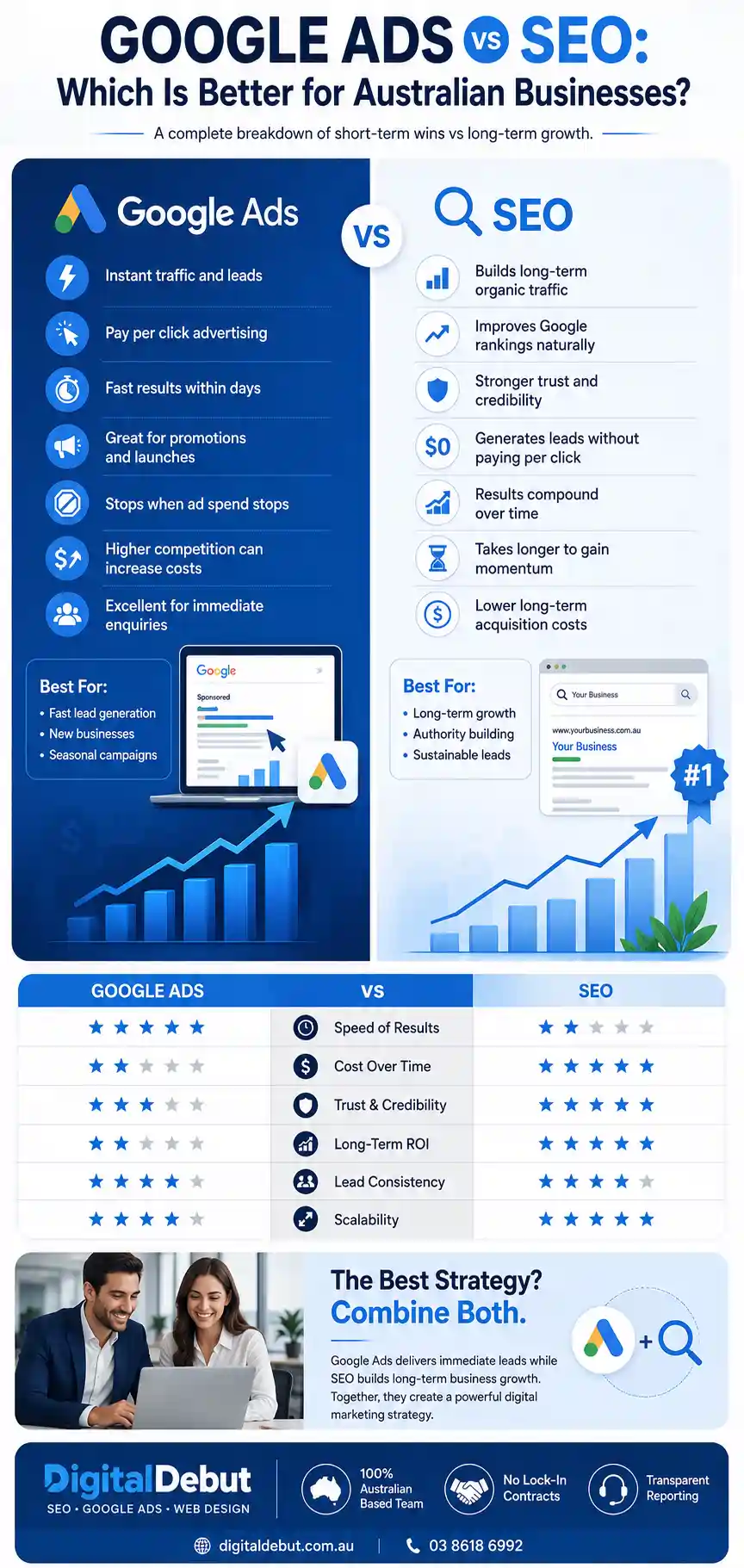
Table of Contents
What Is Google Ads and How Does It Work?
Google Ads (formerly Google AdWords) is a paid advertising platform that lets you place your business at the top of Google search results instantly. You bid on specific keywords, and when someone searches for those terms, your ad appears above the organic results. You pay each time someone clicks. This model is known as pay-per-click, or PPC.
Google Ads gives you speed. The moment your campaign goes live and your budget is approved, your business can appear on page one. There is no waiting period, no slow build-up. For a new business that needs leads immediately, that kind of visibility is genuinely valuable.
But there is a catch. The moment you stop paying, your ads disappear. Your position on Google goes with your budget. Another thing to note is that if your campaigns are not managed carefully, you can burn through thousands of dollars without a single meaningful conversion. We have written in detail about why Google Ads needs to be managed by a professional and the financial damage that poorly run campaigns can cause.

What Is SEO and How Does It Work?
Search engine optimisation (SEO) is the process of improving your website so that Google ranks it higher in the organic, unpaid search results. When someone types “electrician in Brisbane” or “best accountant Sydney” and your website appears without you paying for that click, that is SEO doing its job.
SEO covers a range of activities: optimising your page content, improving your site structure and speed, building quality backlinks, creating relevant blog content, and ensuring Google can properly crawl and index your site. It is a layered, ongoing effort, not a one-time task.
SEO results take time to materialise, as Google will need to trust your website before it ranks it. It typically takes three to six months before significant ranking movement occurs, and sometimes even longer to see substantial organic traffic growth for competitive keywords. But once those rankings are established, they can generate leads month after month without an ongoing ad spend attached to every click.
Understanding what drives Google rankings is the foundation of any SEO strategy, and we break this down clearly in our guide on how to improve your Google ranking.
The Core Difference: Renting vs Owning
The most useful way to think about Google Ads vs SEO is the difference between renting and owning.
Google Ads is renting visibility. It is fast, flexible, and controllable. You can turn it on and off, increase spend during busy periods, and target very specific audiences. But you are renting your position from Google. Stop paying, and you are gone.
SEO is building an asset. It takes time and consistent investment to develop, but the results compound over time. A well-ranking page can bring in traffic for years. That organic presence belongs to your business. Nobody can take it away by outbidding you.
Neither approach is universally better. The right choice depends on your goals, your timeline, and your budget
When Google Ads Makes More Sense
Google Ads is the stronger choice in several specific situations.
You Need Leads Right Now
If you have just launched a business or you are entering a new market, you cannot afford to wait three or so months for SEO to kick in. Google Ads gives you immediate exposure to people who are actively searching for what you offer. For a new trade business, a new law firm, or any service-based company needing to fill the pipeline quickly, that speed is worth paying for.
You Are Promoting Something Time-Sensitive
Seasonal promotions, product launches, events, and limited-time offers are all better served by Google Ads. You can set precise start and end dates, control exactly what messaging appears, and switch campaigns off the moment the promotion ends. SEO simply cannot operate at that pace.
Your Keywords Are Extremely Competitive
In some industries, achieving top organic rankings for high-volume keywords takes years of sustained effort and significant investment. Personal injury lawyers, financial advisers, and insurance providers operate in spaces where the SEO competition is fierce. Running ads can give you page-one visibility while your SEO strategy builds momentum behind the scenes.
You Want Precise Control Over Targeting
Google Ads lets you target by location down to a suburb, by device, by time of day, and by specific audience types. If you only want to show ads to people within three kilometres of your shopfront on weekday mornings, you can do exactly that. This level of granularity is not something SEO can replicate.
When SEO Makes More Sense
SEO is a stronger long-term investment in many cases, and for good reason.
You Want Sustainable, Compounding Results
Once your website earns solid organic rankings, those rankings can hold for months or years with maintenance. Every visitor from organic search costs you nothing per click. Compare that to Google Ads where every single click is a cost, and the value of SEO becomes very clear over a long enough time horizon.
You Are Building Brand Authority
Studies consistently show that users trust organic search results more than paid ads. Appearing in organic results signals credibility. If you rank on page one organically, people perceive your business as an authority in your field. That trust translates to higher click-through rates and better quality leads.
For Australian small businesses in particular, local SEO is an enormously valuable channel. We break down exactly why in our article about the top reasons local SEO services matter for small businesses.
Your Budget Is Limited Long Term
Google Ads costs money every single month. For many small businesses, especially in competitive industries, the cost-per-click can be substantial. A plumber in Melbourne might pay $15 to $40 per click on competitive terms. SEO requires upfront investment, but once rankings are established, the ongoing cost-per-lead is significantly lower than sustained paid advertising.
You Want to Build a Digital Asset
Your website, when properly optimised, becomes a business asset that grows in value over time. It attracts organic traffic, builds domain authority, and works for you around the clock. That is very different from ad spend, which delivers results only while the budget is active.

The Cost Comparison: What Do You Actually Pay?
Understanding the real cost of each channel helps you make smarter budget decisions.
Google Ads costs vary widely by industry. In low-competition niches, you might pay $1 to $10 per click. In high-competition professional services, legal, financial, or medical sectors, clicks can cost $20 to $60 or more. Even with tradies, some clicks can cost up to $50 depending on how specific the word is. Furthermore, you also pay for irrelevant clicks from people who had no intention of buying, unless your targeting and negative keyword lists are tightly managed.
SEO investment is typically structured as a monthly retainer with a digital marketing company, or as a project-based fee for specific work such as a technical audit or content campaign. Quality SEO in Australia generally starts from around min $1,500 to $2,000 per month for meaningful work. The return on investment over 12 to 24 months typically outpaces the equivalent spend on Google Ads for most business types.
The important thing to understand is that cheap SEO is not SEO. It is a risk. Tactics that cut corners can result in Google penalties that destroy your rankings overnight. We explain this in detail in our article on why you should never pay for cheap SEO.
Can You Do Both Google Ads and SEO at the Same Time?
Absolutely, and for many businesses this is the smartest approach. Google Ads and SEO are not competitors. They complement each other well when used strategically and form part of a holistic online marketing strategy.
A common and effective approach is to run Google Ads while your SEO builds momentum. The ads provide immediate traffic and lead generation. Meanwhile, your SEO investment is steadily improving your organic rankings. Over time, as your organic presence strengthens, you can reduce your ad spend without losing overall visibility. Eventually, you may be able to rely primarily on organic traffic, using ads selectively for high-intent keywords or seasonal pushes.
Another benefit of running both simultaneously is the data. Google Ads campaigns can reveal which keywords convert best, giving your SEO team valuable intelligence about where to focus content and optimisation efforts.
The Role of Your Website in Both Strategies
One thing both Google Ads and SEO share: they both depend on the quality of your website. Sending paid traffic to a slow, confusing, or poorly designed website is like pouring water into a leaking bucket. Your conversion rate will suffer regardless of how good your ads are.
Similarly, Google will not rank a poorly built website in organic search, no matter how strong the content is. Technical issues, slow load times, and poor mobile experience all hold back SEO performance.
Before investing heavily in either channel, it is worth auditing your website to make sure it is capable of converting the traffic you are about to send to it. A website that loads slowly, looks outdated on mobile, or fails to communicate your value proposition clearly will undermine both your ads budget and your SEO investment. Web design and digital marketing strategy are fundamentally linked, as we explore in our piece on web design’s impact on your digital marketing strategy.
Industry-Specific Considerations for Australian Businesses
The Google Ads vs SEO decision also depends heavily on your industry and location within Australia.
SEO for tradies such as electricians, plumbers, and builders in major cities often see fast returns from local SEO services because people searching for these services are high intent and ready to call. Google Ads can work well too, but local SEO tends to deliver a lower long term cost per lead.
Professional services including accountants, lawyers, and consultants benefit from both channels. Organic rankings build credibility and trust, while targeted ads capture people actively seeking those services right now.
Online retail businesses have a particularly strong case for prioritising Ecommerce SEO. Product and category pages that rank organically for buying intent keywords drive consistent revenue without ongoing ad costs attached to every sale. That said, Google Shopping ads remain a powerful tool for product discovery and can work alongside an SEO driven content strategy.
For businesses in regional areas of Australia, local SEO is often underutilised. The competition for local keywords in regional markets is typically lower than in Sydney or Melbourne, meaning the time and cost to achieve page-one rankings can be considerably less. This represents a genuine competitive advantage for businesses willing to invest in local search.
Common Mistakes Australian Businesses Make With Both Channels
Knowing what to avoid is just as important as knowing what to do.
With Google Ads, the most expensive mistake is running campaigns without proper management. Broad match keywords, missing negative keyword lists, poorly written ad copy, and unoptimised landing pages can burn through budget with very little return. Many businesses have spent tens of thousands of dollars on Google Ads with almost nothing to show for it because the campaigns were set up incorrectly from the start.
With SEO, the most common mistake is expecting results too quickly and abandoning the strategy before it has had time to work. This is very common, and it is unfortunate to see that investment go to waste as people start, and then stop just before it builds momentum. SEO is not a three month project. It is an ongoing investment. Businesses that start SEO, see no dramatic change after two months, and then stop are essentially throwing their initial investment away.
Another SEO mistake is focusing only on rankings rather than conversions. Ranking on page one for a keyword that does not match your buyer’s intent will not generate meaningful leads. Effective SEO targets the right keywords, not just the ones with the highest search volume.
A third mistake many businesses make is ignoring the content side of SEO entirely. Publishing consistent, valuable, keyword-relevant content is one of the most effective ways to build organic authority. If you are not producing content regularly, your SEO progress will be slower than it needs to be. Content is king, but you must also know the problem with creating content just for the sake of creating content.
So, how to Decide between SEO and Google Ads?
If you are still unsure which way to lean, this straightforward framework should help.
Choose Google Ads as your starting point if you are a brand new business that needs leads within 30 days, you are launching a time limited promotion or seasonal offer, you have a higher than average budget and want to test keyword viability quickly, or you are in a highly competitive space where organic rankings will take years to achieve.
Prioritise SEO if you are playing a longer game and want to build a sustainable lead generation asset, you want to reduce your dependency on paid advertising over time, your industry has moderate keyword competition where organic rankings are achievable within 6 to 12 months, or you want to build genuine brand authority in your market.
Invest in both if your budget allows and you want to cover both short-term lead generation and long-term organic growth simultaneously. This is the approach most professional digital marketing agencies will recommend for businesses with a serious growth agenda.
Whatever direction you take, the decision should be grounded in data, strategy, and a realistic understanding of your timeline and budget. Rushing into either channel without proper planning is the fastest way to waste money.
Working With a Digital Marketing Agency
Managing Google Ads and SEO effectively requires genuine expertise. Both channels have significant technical depth, and the landscape changes constantly as Google updates its algorithms and advertising systems.
When choosing an agency to help with either channel, do your homework. Look for transparency in reporting, a clear strategy aligned to your business goals, and a team that can explain what they are doing and why in plain language. Be cautious of agencies that promise guaranteed rankings or instant results. Neither channel works that way, and promises like those are usually a warning sign.
A good digital marketing agency will help you understand which investment makes sense for your specific situation, build a strategy that combines both channels intelligently, and deliver measurable results over time.
Ready to Make the Right Choice for Your Business?
Deciding between Google Ads and SEO, or working out how to balance both, is one of the most important marketing decisions you will make for your business. Getting it right means more leads, better quality customers, and a marketing spend that actually delivers a return.
At Digital Debut, we work with Australian small businesses to build digital marketing strategies that make sense for their goals, their budgets, and their timelines. We do not believe in one-size-fits-all approaches, and we will always give you an honest assessment of what will work for your specific situation.
If you are ready to have that conversation, get in touch with our team today. We would love to help you cut through the confusion and start investing in the channels that will genuinely grow your business.
Google Ads or SEO? Common Questions
Is Google Ads or SEO better for a new business in Australia?
For a brand new business with no existing online presence, Google Ads will deliver faster results because it provides immediate visibility. However, SEO should be started at the same time if budget allows, because the sooner you begin building organic authority, the sooner you will be able to reduce your reliance on paid advertising. Most new Australian businesses benefit from running both channels simultaneously from day one.
How much does Google Ads cost for a small business in Australia?
The cost varies significantly by industry and location. In low-competition niches, you might spend $700 to $1,000 per month and generate a steady stream of leads. In competitive industries like legal services, finance, or healthcare, you may need $3,000 to $10,000 per month or more to achieve meaningful results. The key factor is not just the budget, but how well the campaigns are managed and optimised. We have worked with come brands spending $2 million a month just on Google Ads alone! However, these are big blue chip brands such as Mazda.
How long does SEO take to work in Australia?
Most businesses see meaningful ranking improvements within three to six months of starting a quality SEO program. Significant traffic growth typically takes approximately 3 months, and for highly competitive keywords, achieving top rankings can take longer. The timeline depends on the competitiveness of your keywords, the current state of your website, and the consistency of the SEO work being done.
Can I run Google Ads and SEO at the same time?
Yes, and for most businesses this is the recommended approach. Running Google Ads provides immediate traffic while your SEO investment builds long-term organic visibility. The two channels can also share data: keyword performance in Google Ads can inform your SEO content strategy, helping you prioritise the terms that actually convert rather than just the ones with high search volume.
Does Google Ads affect my organic SEO rankings?
No. Running or not running Google Ads has no direct impact on your organic search rankings. Google keeps its paid and organic systems entirely separate. Some businesses wonder whether spending more on ads leads to better organic visibility, but this is not how Google works. Your organic rankings are determined entirely by SEO factors such as content quality, technical site health, backlinks, and user experience.
What is a good click-through rate for Google Ads in Australia?
Average click-through rates (CTR) for Google Search Ads in Australia typically range from 3% to 6%, depending on the industry and how well the ads are written. Well-optimised campaigns with strong ad copy and relevant landing pages can achieve higher rates. If your CTR is significantly below 2%, it is usually a sign that your ads are not relevant enough to the search queries triggering them.
Is SEO worth it for a small local Australian business?
Absolutely. Local SEO is one of the most cost-effective digital marketing investments for small Australian businesses. For service-based businesses like tradies, healthcare providers, and professional services, ranking well in local search results drives high-intent traffic from people who are actively looking for help in your area. The competition for local keywords in regional and suburban areas of Australia is often lower than people expect, making local SEO particularly achievable.
What happens if I stop doing SEO?
If you stop investing in SEO, your rankings will typically hold for a period of time, but will gradually decline as competitors continue to optimise their own websites. Google rewards fresh, regularly updated content and ongoing technical maintenance. A site that is left unchanged will slowly lose ground to competitors who keep investing. The good news is that a well-established organic presence has more staying power than many people realise, but ongoing maintenance is important to protect and grow what you have built.
How do I know if my Google Ads are working?
The most important metrics to track are conversion rate, cost per conversion, and return on ad spend (ROAS). Getting clicks is not enough. You need to track whether those clicks are turning into leads, enquiries, or purchases, and at what cost. Google Ads provides detailed reporting that makes this possible. If your campaigns are not set up with proper conversion tracking, you are essentially running blind and have no reliable way to measure their effectiveness.
Should I hire an agency for Google Ads or can I do it myself?
Google Ads is technically accessible to anyone, but managing campaigns effectively is considerably more complex than the platform’s simple interface suggests. Poorly managed campaigns can waste large amounts of money very quickly. For most small businesses, the cost of professional management is recovered many times over through improved campaign performance and avoided wasted spend. If you are serious about using Google Ads as a growth channel, professional management is strongly recommended.