How to Write Meta Descriptions That Get Clicks
Posted on
- 2 July 2026
Are Your Meta Descriptions Costing You Customers?
Picture this. Your website is on page one of Google. You fought hard to get there, you have spent time and money with your SEO company, and you are watching your ranking with a sense of relief. But the traffic is not coming in like you expected. The enquiries are inconsistent. Something is off.
More often than not, the issue is staring right back at you in the search results. Your meta description is not doing its job.
That little snippet of text below your page title is a tiny but surprisingly powerful piece of real estate. It does not move you up or down in the rankings. Google has said as much. But it absolutely controls whether someone sees your result and thinks “yes, that is exactly what I need” or scrolls past to the next option. And for an Australian business (or any business really) where every lead has value, losing that click matters.
We have reviewed hundreds of Australian business websites over the years, and poor meta descriptions are almost universal. They are either missing entirely, copy-pasted across every page, stuffed with keywords, or written like a legal disclaimer rather than a reason to click. The fixes are not complicated, but they do require thinking like a potential customer rather than a website manager.
Table of Contents
What a Meta Description Is, and What Google Actually Does With It
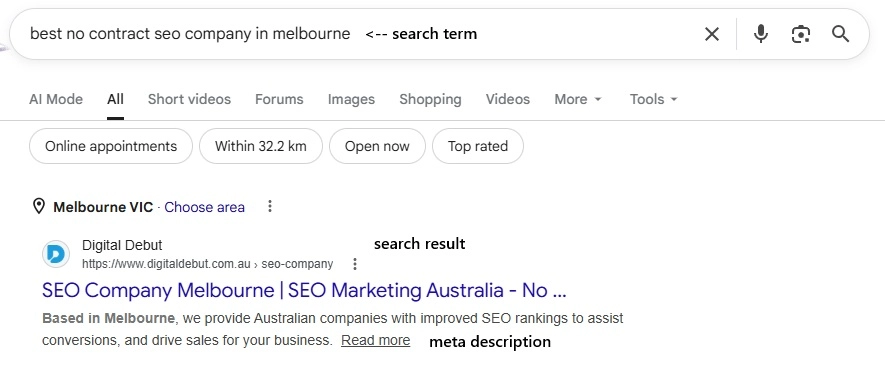
A meta description is an HTML tag in the head of your page. In a search result, it appears as the grey-ish paragraph of text beneath your blue clickable title. That is the version you control, or try to.
Here is the honest reality though. Google does not always show what you write. Industry studies have found it rewrites meta descriptions somewhere between 60 and 70 percent of the time. For a lot of SEO advice out there, that fact gets buried or glossed over. We would rather be upfront about it.
Google rewrites your description when it thinks the page body has something more relevant to the search query than your description does. That happens most often when descriptions are too vague, when they do not closely match the page content, or when the same description is recycled across multiple pages.
The good news is that writing a genuinely strong, page-specific description makes Google far more likely to use yours. And even when it does pull from the body text, having good content to pull from means the automated version is at least readable. So the effort is never wasted, even if the outcome is not always guaranteed.
For businesses working with an SEO agency, meta descriptions are usually part of a broader on-page audit. They are not the first thing a new campaign focuses on, but they are almost always on the list. Sometimes they move the needle faster than anything else, because you are improving pages that are already ranking rather than waiting for new content to build authority.
The Length That Works in Practice
Desktop results cut off meta descriptions at around 145 to 155 characters. Mobile is shorter, depending on the device and what was searched. If your description runs past that and gets cut off mid-thought, it looks unprofessional in a place where professional appearances count for a lot.
The practical sweet spot is 145 to 150 characters. Long enough to say something worthwhile. Short enough to land fully on screen.
Do not go too short either. A description of 60 characters gives Google very little to work with and almost always triggers a rewrite. Use your character count allowance. Just use it well.
Tools like Yoast SEO and Rank Math have a live preview that shows you exactly how the title and description will look in a search result as you type. Use it. Editing blindly and hoping the truncation falls in a sensible place is not a strategy.
What Makes Someone Actually Click Your Result
The psychology here is worth slowing down on. A person searching Google is rarely relaxed. They have a problem, a question, or a decision to make. They are scanning fast. They want the most obvious, most relevant result and they want it quickly.
Your meta description has somewhere around a second to register as the right choice before they move on. That is not a lot of room for scene-setting.
The descriptions that convert consistently well tend to do a few specific things:
They open with the outcome, not the process. Instead of:
“This page explains the concept of local SEO and its benefits for small businesses,”
something like:
“Find out why your business is not showing up in local Google searches, and exactly what to do about it”
puts the reader’s problem front and centre immediately.
They include the keyword naturally, close to the start. When the search query matches words in your description, Google bolds them. Your result looks more relevant than the competitors whose descriptions do not echo the query. Do not cram the keyword in awkwardly. If it disrupts the sentence, rewrite around it.
They close with a clear action. “Book a free consultation,” “Get the full guide,” “See our case studies,” “Find out how.” These matter because they remove uncertainty about what happens when you click. Uncertainty is a reason not to click.
They include something specific and differentiating. “Serving Melbourne businesses since 2012” or “No lock-in contracts” or “Free quote in under 10 minutes” beats “We provide quality services” every single time. Specificity creates credibility. Vagueness creates doubt.
On-Page SEO vs Off-Page SEO: Getting the Balance Right
The distinction between on-page and off-page SEO causes a lot of confusion, so let’s make it simple.
On-page SEO is everything within your control on your own website. Off-page SEO is primarily the links other websites point to yours. Those links act as votes of confidence, signalling to Google that your content is trustworthy and worth ranking.
You need both. A page with strong on-page optimisation but no backlinks will struggle to rank for competitive keywords. A page with strong backlinks but poor on-page SEO will underperform because Google cannot clearly match it to specific searches.
The businesses that get the best results treat these two things as complementary priorities rather than alternatives. If you want a clearer picture of what your website needs across both areas, talking to a qualified SEO company like ours is often the fastest way to get an honest assessment.
Writing Descriptions for Each Type of Page
The approach is not the same across every page on your site. Applying one template everywhere produces descriptions that perform averagely everywhere, which means performing strongly nowhere.
Your Home Page
The home page description carries the broadest job. It needs to capture who you are, what you do, and who you serve in a single breath. For a digital marketing company working with Australian clients:
“Aussie digital marketing. SEO, Google Ads, and web design. Helping businesses grow online since 2015. Book your free strategy session today”
That covers identity, services, credibility, and a call to action in under 155 characters.
Service Pages
Service page descriptions should focus on the result the client gets rather than a description of what the service involves. For a Google Ads management page:
“Google Ads management that cuts wasted spend and delivers measurable ROI for Australian businesses. No lock-in contracts. Book a free audit.”
The client cares about outcomes and removing risk. Both are addressed.
Blog Posts and Information Pages
Blog descriptions should tease the key insight without revealing everything. Give the reader just enough to know the article has what they need, but make them want to read it to get it.
“Most businesses write meta descriptions that blend into the SERP. Here is the structure that makes yours stand out and earn more clicks.”
That is a specific promise of value that earns the click.
Location Pages
For businesses targeting specific areas, the location name should appear naturally in the first 80 characters. This is foundational local SEO practice. A searcher looking for a plumber in Geelong wants to see “Geelong” in your result before they click, not discover your location only after landing on the page.
Product Pages for eCommerce
Product descriptions benefit enormously from practical specifics: price range, delivery timeframes, return policy, key features.
“Buy the XYZ Widget online. Ships across Australia in 2 to 3 business days. Free shipping on orders over $50. Lowest price guaranteed.”
That answers the questions a buyer has before clicking. Fewer unresolved questions equals higher CTR.
Mistakes That Are Costing You Clicks Every Single Day
These are the patterns we see most often on Australian business websites, and they all have a real cost.
No description at all. Google generates one automatically when there is nothing there, pulling text from wherever on the page it decides is relevant. The result is almost always disjointed and written for a crawler, not a person. It is one of the fastest wins available because the bar is so low.
The same description duplicated across every page. If your home page, your services page, your about page, and your contact page all share the same 150 characters, you are treating every searcher as if they searched the same thing. They did not. Each page serves a different intent, and the description should reflect that. Google Search Console flags duplicate descriptions as a site quality issue too.
Keyword stuffing. Repeating the target keyword three times in 155 characters is not persuasion. It is noise. Users scanning results can spot it immediately, and it signals nothing about the quality of what is on the page. Write for the reader first, every time.
Promising something the page does not deliver. If the description says “Get an instant free quote” and the page is a contact form that takes three days to get a response, you have created a trust problem on first contact. Accuracy in the description is not just ethical. It protects your bounce rate.
Writing passive sentences and corporate language. “Services are provided to clients seeking solutions for their digital marketing requirements” is technically a sentence. But nobody thinks or speaks like that. Write descriptions the way you would explain your business to someone at a networking event. Conversational. Direct. Human.
Click-Through Rate and the Long Game
CTR is the share of people who see your result and actually click it. On a competitive keyword with solid impressions, even a two percent improvement in CTR produces a meaningful increase in monthly traffic. For many Australian small businesses, that margin is the difference between a slow month and a strong one.
There is a broader compounding effect too. Stronger CTR across your site tells Google that your pages are relevant and engaging to real searchers. That engagement signal, combined with solid on-page SEO fundamentals, can support improved rankings over time. The pages that perform best in search tend to be pages that users genuinely respond well to. Descriptions that earn clicks are a measurable part of that.
Track it in Google Search Console. The Performance report breaks down impressions, clicks, and CTR by page and by query. Pull the data, find your worst CTR pages among those with the most impressions, and start there. Rewrite those descriptions, wait four to six weeks, and compare. The feedback is faster here than almost anywhere else in SEO, which makes it a satisfying area to work on.
This kind of optimisation effort connects closely to the work explained in our guide to how long SEO really takes, because understanding the compounding nature of these improvements helps set realistic expectations for what each piece of the puzzle contributes.
How to Build a Habit That Actually Sticks
The first round of rewrites is the biggest lift. After that, it is about maintenance and iteration.
Set a quarterly reminder to pull your Search Console CTR data. Look at your top 30 pages by impressions. Sort by CTR, lowest to highest. The bottom 10 are your next targets. Write the rewrites, note the date you made the change, and check back in six weeks.
Search your core keywords every month or two and look at what your competitors are writing. When everyone in a category is using similar language, the opportunity to stand out is obvious. If you all sound the same, being slightly different is an advantage.
Update descriptions when your business changes. A new service launch, a seasonal promotion, a new location. These create natural reasons to refresh descriptions and align them with what is most relevant right now.
None of this is glamorous. But meta descriptions are one of the few areas where the work is small, the impact is measurable, and the feedback comes back quickly. That combination is rare in organic search, and businesses that take it seriously tend to outperform those that treat descriptions as set-and-forget.
The technical side of this work, including how pages are indexed, how site speed affects user experience, and what happens under the hood when a user clicks your result, is covered in our plain-English guide to technical SEO for business owners.
Side by Side: What Good Looks Like vs What Does Not Work
Three examples from Australian industry contexts, comparing weak descriptions with stronger alternatives:
Digital marketing agency
Weak: SEO services and digital marketing. Contact us today to learn more.
Stronger: SEO and Google Ads for Australian businesses that want real results. No lock-in contracts. Book a free strategy session with our team today.
Residential builder
Weak: We build homes across Melbourne. Get in touch for a quote.
Stronger: Custom home builders in Melbourne with over 20 years experience. Fixed-price contracts, no surprises. Request your free design consultation today.
Accountant
Weak: Accounting and tax services for individuals and businesses.
Stronger: Brisbane accountants helping small businesses pay less tax, legally. Fast turnaround, upfront fees, no surprise bills. Book a free 20-minute call.
The stronger versions are not stronger because they are longer. They are more specific, more human, and more focused on what the person searching actually wants to know before they click. That is the whole game.
Improving your descriptions also works in conjunction with making sure your Google Business Profile is properly set up and optimised, particularly if you are a local business. More detail on that process connects with the guide to ranking on Google Maps for local searchers.
Questions About Meta Descriptions
Do meta descriptions affect where I rank on Google?
No, not directly. Google has confirmed that meta descriptions are not a ranking signal. What they do influence is your click-through rate, which is how many people actually visit your page after seeing it in search results. Better CTR means more traffic from the same rankings, which has its own compounding value over time.
How long should a meta description be for my website?
The same character limits apply globally. Aim for 140 to 155 characters for desktop visibility. On mobile, descriptions can be cut off around 120 characters, so make sure your most important information appears in the first half of the description. Use the preview feature in Yoast or Rank Math before publishing.
What happens if I leave my meta description blank?
Google generates one automatically from the page body. The result is rarely compelling and almost never a great sales pitch for your business. You give up direct control over the message shown to potential visitors at the exact moment they are deciding whether to visit your site. Always write a deliberate description for pages that matter commercially.
Should I include keywords in my meta description?
Yes, but write naturally first. When the words in your description match the user’s search query, Google bolds them in the snippet. Your result visually stands out. Do not force the keyword in if the sentence reads awkwardly around it. A great description without the keyword often outperforms a keyword-stuffed one that reads poorly.
Can I use the same meta description on multiple pages?
Avoid it entirely. Each page on your site serves a different intent and should have a description that reflects that. Google Search Console flags duplicate descriptions as a site quality issue. More importantly, duplicate descriptions miss the chance to match the specific query intent of users who land on different pages through different searches.
How often should I update my meta descriptions?
Do a full audit every six to twelve months at minimum. In between, update descriptions when your offer changes, when you launch something new, or when your Search Console data shows a ranking page with unexpectedly low CTR. Descriptions are not set-and-forget. The competitive context in the SERP changes regularly, and your copy should keep pace.
Will better meta descriptions directly boost my Google rankings?
Not directly. But they improve CTR, and improved CTR means more traffic without a rankings change. Combined with strong on-page SEO, good page speed, and quality content, better descriptions are part of the overall engagement picture that search engines use to assess page quality over time.
What is the actual difference between a meta title and a meta description?
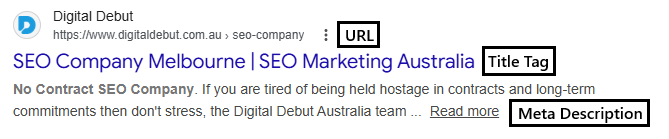
The meta title (title tag) is the clickable headline in search results and is a direct ranking factor. The meta description is the supporting text beneath it and is not a ranking factor, but it is the primary driver of whether someone clicks your result after seeing it. Both need to be optimised for different reasons and they should work together, not repeat the same information.
Should the description repeat the page title word for word?
No. The title gets the user’s attention and is used for ranking. The description earns the click. If they say the same thing, you have wasted the description. Use the description to expand on what the title promises, answer an implicit question the title raises, or add a specific reason to choose your result over the others on the page.
Can meta descriptions help with voice search?
Increasingly, yes. Voice assistants pull answers from concise, clearly written content that closely matches the spoken query. Descriptions written in natural, conversational language that directly answer a question are more likely to be surfaced for voice queries. This matters more for question-based searches like “what is the best way to find an SEO agency near me” than for transactional queries.
More Clicks Start With Better Meta Descriptions
There are not many places in SEO where you can make a change today and see a measurable result within weeks. Meta descriptions are one of them. For any page already ranking on page one, the description is the only thing standing between that ranking and the traffic it should be generating.
Most Australian businesses have rankings that could be working harder. The descriptions are often the reason they are not. The fixes are not technically complex. They just require thinking clearly about what the person on the other side of that search result actually wants to know before they click.
If you want to understand exactly where your site is leaving traffic on the table, whether that is through meta descriptions, on-page content, technical issues, or something else entirely, the team at Digital Debut can walk you through it. We work with Australian businesses of all sizes to identify and act on the real opportunities in their search presence.
Get in touch with Digital Debut today to book a free strategy session and find out what your website could genuinely be doing better in search.