How to Do Keyword Research: A Real Guide for Australian Businesses
Posted on
- 3 April 2026
We get calls from business owners who have been doing SEO and blogging for a year and have nothing to show for it. No traffic bump, no new enquiries, nothing! And almost every time, the diagnosis is the same. They never figured out what their customers were searching for. They wrote content for a phantom audience. Keyword research would have fixed that before they wasted twelve months with their current SEO company.
So, here is the honest version of how keyword research works. No jargon padding. Just the process, the tools, and the mistakes that catch people out. Getting this done right is the first and one of the most important steps on how to improve your Google rankings on words that actually matter!
Table of Contents
This Is Why You Cannot Skip Keyword Research
Some clients push back on this. “I know my industry. I know what my customers want.” Fair enough. But knowing your industry and knowing how your customers search Google are two very different things.
Take a physio in Canberra we worked with. She was absolutely certain her customers searched for “physiotherapy.” They did not. The bulk of the searches coming through her area were things like “knee pain treatment Canberra,” “sports injury physio near me,” and “why does my shoulder hurt when I lift.” She had been targeting the wrong terms entirely, and her competitors had quietly taken all the traffic she should have been getting.
Keyword research is what tells you the actual words real people type. Not the words you wish they would use. The words they do use.
Yeah sure “physiotherapy” gets heaps of views, but lets be real, it will cost a lot of money to get to the top on that word alone, and once you are there, the conversion rate will be very low as it is very broad term. If many people come to your website on such broad terms, and do not really engage and enquire, then Google will eventually derank you unless your website is the health direct government website which is holding the top positions, followed by a number of non for profit organisations.
Understand Search Intent: Read This Before You Touch Any Tool!
Before you open a single keyword spreadsheet or planner, you need to understand search intent. This concept alone will save you from some of the most common and costly SEO mistakes.
When someone types a query into Google, they have a reason. A goal. Google has spent billions of dollars figuring out what that reason is, and it rewards content that matches it. Write a page that mismatches intent, and it simply will not rank. Does not matter how well optimised it is.
Informational Intent
Someone trying to learn something. "How to do keyword research," "what is a backlink," "tips for writing an About page." They want knowledge, not a sales pitch. A blog post or guide suits this well.
Navigational Intent
Means someone is looking for a specific brand or site. "Digital Debut Melbourne," "MyGov login," "ATO website." These searches are already brand-loyal. Hard to intercept.
Commercial Intent
When someone is in comparison mode. "Best Digital Marketing Company Melbourne," "Ahrefs vs SEMrush," "web design packages Melbourne." They are close to a decision and doing final research. Detailed comparison content, case studies, and service pages with clear differentiation work well here.
Transactional Intent
Now someone who is ready to convert. "Get local SEO services quote Melbourne," "book a web design consultation." These people want a clear next step. Give them a landing page with a form, not a three thousand word blog post.
Matching the right content type to the right intent is half the battle. It is not complicated, but it requires you to think about every keyword from your customer’s perspective rather than your own.
Building Your Keyword Seed List
Start simple. Grab a notepad (I love using Notepad++) and write down every word or phrase a customer might use to describe what you do. Not technical terms. Not industry jargon. The plain language a non expert would use when they have a problem you solve.
- A mortgage broker might write down: home loan, mortgage, refinancing, first home buyer, low interest rate home loan, borrowing capacity.
- A bookkeeper might write: bookkeeping, BAS, GST help, Xero bookkeeper, small business accounting.
- A landscaper might start with: landscaping, garden design, turf laying, retaining wall, garden makeover.
These are your seeds. They are broad and mostly unrankable as they stand. Too much competition. But they are the starting point for everything that follows!
Now type each seed (search term) into Google. Do not press enter yet. Just watch what the autocomplete dropdown suggests. Every suggestion is a real phrase that real people search. Write them down. Scroll to the very bottom of the results page and look at the “Related searches” section. More real phrases. More ideas. Spend ten minutes doing this and you will have min 50 keyword ideas without opening a single tool.
The Tools That Actually Help
Once you have your initial ideas, it is time to add data. Which of these keywords gets meaningful search volume? How hard is it to rank for them? What else is out there that you might have missed?
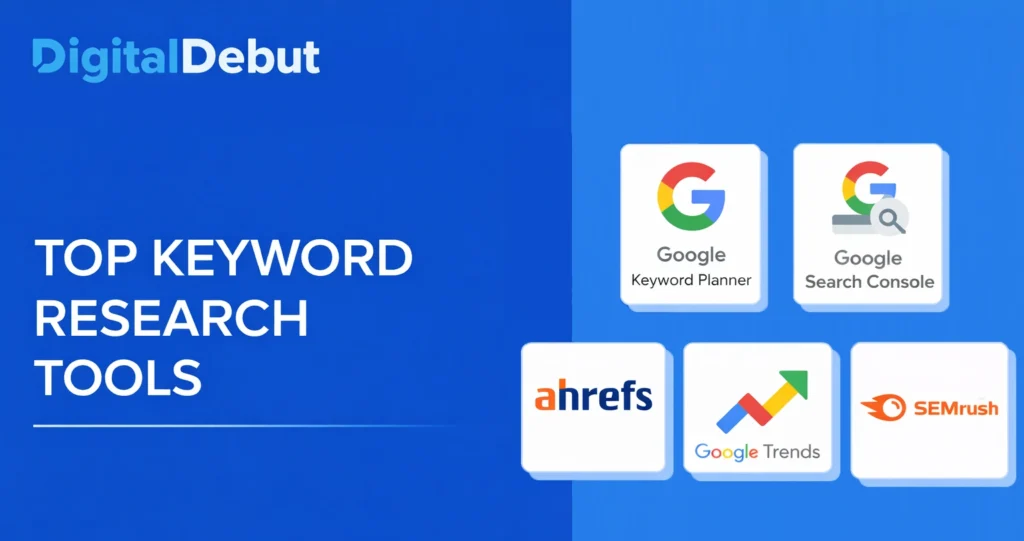
Google Keyword Planner is free and does the basics. You get volume ranges and competition indicators. It is not super precise, but it is enough to tell the difference between a keyword that gets searched a thousand times a month and one that gets searched ten times. Filter by Australia specifically. Global numbers are meaningless for a local business.
Note: even free, it will give a range such as 100 – 1,000 searches per month. If you are running Google Ads it will give you more accurate numbers.
Google Search Console is not bad, but not good and almost nobody uses it to its full potential. If your site already has any traffic at all, Search Console shows you queries bringing people to it. It is worth having a look!
SEMrush and Ahrefs are the paid tools worth knowing. Both show monthly volume, a keyword difficulty score, and a full breakdown of which competitors are ranking for any keyword and what traffic they are getting from it. The competitor keyword gap feature, where you see what competitors rank for that you do not, is worth the price of admission alone.
Google Trends is free and tells you whether interest in a keyword is growing, shrinking, or seasonal. Invaluable for planning content around peak demand periods in your industry.
Pick two tools. Learn them properly. Using five tools half-heartedly is worse than using one well. However, please understand, none of these tools will give exact data, but it still is an extremely important part of the research phase.
How to Evaluate a Keyword
You have a long list. Now you need to cut it down to the ones worth targeting. Three filters apply here.
Search volume tells you whether people are searching for that phrase. In Australia, volumes are lower than in the US or UK simply because the population is smaller. A phrase with 300 searches a month in Australia is very valuable for a local business. Do not dismiss keywords just because the volume looks modest by global standards.
Keyword difficulty is the score that tells you how hard it will be to rank. New sites and smaller sites should prioritise lower difficulty keywords. Not because the hard ones are not worth ranking for eventually, but because you need wins to build authority first. Chase a difficult keyword with a new site and you will wait years, also it may never rank depending on your SEO budget. Chase a lower difficulty keyword with the same site and you could be on page one within months, maybe sooner! We had a client (BCSM) who sell pallets, they came to us with a brand new website and barely any content, only AI copy and paste. We told them it will take at least 4 month before they new customers pouring in. At the same time we targeted a bunch of less competitive and longer tail search terms, created unique human written content around it, and uploaded it to the most appropriate pages. Within 2 weeks they hit page 1 rankings for some of their target keywords and new customer enquiries soon followed. For more information please check our post on Quickly improve your rankings.
Relevance is the filter that no tool can apply for you. Would someone who typed a specific keyword, landed on your page, and read your content which will give them a reason to contact you or buy from you? If the answer is no, the keyword is not relevant regardless of its volume. High traffic from the wrong audience is not an asset.
A keyword that clears all three filters is worth pursuing. One that only passes one or two needs more thought before you commit to building content around it.
Why Long tail Keywords Are Where Small Businesses Win
Long tail keywords are specific, longer phrases. They have lower volume and far less competitive, but they often much closer to a purchase decision. Someone who is searching for longer tail phrases are towards the end of the consumer buying cycle and ready to make a purchase decision. These keywords are gold and if you are not coming up for them, you are losing business.
Example: the search term “accountant” is dominated by one of the Australian government websites, Swinburne University (when searching from VIC), Finder, and a dozen comparison directories. No small accounting firm is ranking for it without millions in marketing spend. But the word “small business accountant Wollongong” or “Xero bookkeeping setup for tradies”? Those are genuinely winnable with solid content and some patience.
Long tail keywords are also the way to capture people who are specific about what they want. Specific buyers are better buyers. Someone searching “affordable no-contract SEO Melbourne small business” knows exactly what they want. They are doing less browsing and more evaluating. That is the traffic worth capturing. However, be careful with how you structure your content, if you are just placing random long tail search terms within your website content where it does not make sense to, or without context, you are simply creating content for the sake of creating content and Google will ignore it.
Local SEO Keyword Strategy for Australian Businesses
Location targeting is not optional if you serve customers in specific areas. The mistake is targeting keywords without location modifiers and ending up visible to people two states away who will never become customers.
Add your city, region, or suburb to your core service keywords. “Plumber Fitzroy,” “mortgage broker Gold Coast,” “graphic designer Fremantle.” These localised terms carry much stronger commercial intent and face a fraction of the competition of their bare equivalents.
Suburb-level content is one of the most misunderstood and abused local SEO tactics in Australia. If you actively serve five or six suburbs, having targeted pages or content for each of them is a genuine competitive advantage. However, just adding a bunch of suburb pages to trick Google into ranking with no uniqueness or carefully thought out content will not do you any good. This is what we mean when we say it is the most misunderstood and abused strategy when it comes to SEO. There is a detailed breakdown of how this works in practice in this post about whether to add suburb pages to your SEO strategy.
Quick Tip: For Australian English. Write “optimise” rather than “optimize.” Use “colour” rather than “color.” Google handles both, but writing in the natural language of your Australian audience signals authenticity and alignment. Small thing. Worth doing consistently.
Competitor Keyword Research: Find What Is Already Working
You do not have to invent your keyword strategy from scratch. Your competitors have already done years of trial and error. Some of that has resulted in pages that rank well. You can see exactly what those pages target.
In SEMrush or Ahrefs, enter a competitor’s domain. You will see every keyword they rank for, their average position, and the estimated monthly traffic that comes from each term. Look specifically at keywords where they sit between positions four and fifteen. Those are positions that can be taken with a better, more thorough piece of content.
The keyword gap tool takes this further. Enter your domain and two or three competitors, and it shows you every keyword your competitors rank for that you do not. These are your blind spots. Gaps in your coverage that are already proven to drive traffic in your industry.
This is strategy, not copying. You are identifying demand that already exists and figuring out where you are not capturing it yet.
Mapping Keywords to Your Website
A keyword list is not a content strategy. To make it useful, every keyword cluster needs to be assigned to a specific page on your site. This is keyword mapping, and it is where a lot of the real SEO value gets unlocked.
Each page gets a few primary keywords followed by supporting keywords. The primary keyword appears in the page title, the H1, the URL slug, the opening paragraph, and several times throughout the content in a natural way. Supporting keywords appear where they fit naturally. No stuffing!
Keyword mapping prevents cannibalisation. This is the ugly problem that happens when multiple pages target the same keyword. Google cannot easily decide which one to rank, so it often ranks neither particularly well. A mapped keyword list makes this immediately visible before it becomes a problem.
Example, we have (had) a wedding entertainment client which we got them to number 1 of Google for their most important search term in under 2 months, where other agencies could not do for years. Their whole business revolves around wedding entertainment. They then have another page on wedding entertainment, but it is listed just as a gateway page to branch off onto their main service pages. The strategy was going well. A social media marketing person comes inhouse for them (I am sure you can see where is going) and start questioning the SEO strategy and the homepage should be focused “wedding storytelling” (or some weird word) instead. Of course, anyone who knows SEO would say it is a bad idea. Anyway, long story short, the client was convinced that our strategy in which we got them to number 1 and held that position for a very long time wasn’t the right strategy and ceased business with us. We will monitor ranking positions over the next 4 – 6 months and see what happens. It really saddens us when customers stop work with us and then a few months later start to experience a slow decline in business. Does this mean we can win them back? No, because people have pride and ego and do not like to admit they are wrong in most cases. Nothing wrong with that, most of us are like that! The point of this is that we had a very important keyword, correctly targeted and optimised to the right page, and now this will not be the case. Google will get confused and rankings will drop!
SEO is one of the most misunderstood practices when it comes to online marketing. Educate you clients as much as you can and make them see the value in your work. Show them rankings, traffic increases, conversions going up from organic search. Even show them path to conversion. Ok, now we are giving advice to help other competitors! But who cares, no one is as good as us! ok, well most aren’t! 😉
Keyword mapping is very important and is the main part of any website content strategy. Get this wrong, you will confuse Google and also your searches which means low rankings.
Quick tip: Keep a simple spreadsheet. Page URL, primary keyword, secondary keywords, and intent type. SEM Rush shows this. Maintain it every time you add content or make significant updates. For a broader picture of the on-page factors that sit alongside keyword targeting, the guide on what to optimise when starting SEO is worth your time. Simple and super effective!
Tracking Performance and Keeping the Strategy Up To Date
Keyword research done once and never revisited is like doing a business plan in 2019 and running on it unchanged through a pandemic, sorry SCAMdemic (mf’s) and beyond. The world moves. Your keyword strategy needs to move with it.
Use the tools we have been talking about to see how your keywords, pages, and other keywords you are not targeting are going. Flag pages sitting between positions eight and twenty. Those are the candidates for targeted improvement. Sometimes a few additional paragraphs, FAQs, some better internal linking, or a more descriptive title tag is all it takes to move them onto page one.
Do a proper keyword audit twice a year. Look at what is ranking, what has slipped, and what new opportunities have opened as your domain authority grows. New keywords that were previously too difficult for your site may now be in reach.
The search landscape has also shifted significantly with AI generated search summaries becoming part of the results page. Understanding how to be found in those results is becoming an important part of keyword strategy. This post on how to get your business found in AI search covers the practical steps. And if your site is not ranking despite what feels like a solid strategy, the diagnostic guide on why your website is not ranking on Google identifies the most common culprits.
Common Mistakes That Kill Keyword Strategies
A few patterns cause keyword strategies to fail that are worth flagging explicitly.
Targeting zero volume keywords is more common than you would think. A phrase that sounds searchable might have a total of 5 searches per month nationally. You could rank number one for it and get almost nothing. Volume validation is non-negotiable, unless it is a longer tail search term.
Targeting terms that are too broad for your domain authority is a trap. A new site chasing “mortgage broker” will be invisible for years, probably forever! Focus your energy where you can win first. Build the foundation before you go after the competitive terms.
Ignoring intent produces pages that rank but do not convert. A blog post ranking for a transactional keyword will get clicks from people who immediately hit back when they find a wall of text instead of a quote form.
Never refreshing your keyword list means missing shifts in how your customers search. Industries change. Language evolves. Google’s understanding of queries improves. A keyword strategy from two years ago may have real gaps compared to current search behaviour.
Neglecting to connect keyword research to content planning means you end up with research that sits in a spreadsheet while your content team writes whatever it feels interesting that week. Or whatever they feel like copying and pasting from AI tools. Keyword research only creates value when it drives what gets published which is all based on what ever have been talking about.
Get Your SEO Strategy Built on Real Data
If you have been guessing at keywords, you are not alone. Most businesses start there. But at some point, guessing stops being good enough, and what you need is a strategy built on actual search data, properly mapped to your pages, and tracked over time for measurable results.
That is what we do at Digital Debut. We have been building keyword strategies for Australian businesses for over fifteen years, and the process we use is grounded in research, not assumptions. If your site is not bringing in the enquiries it should, keyword strategy is usually where the fix starts.
Talk to the Digital Debut team today and let us take a proper look at where your keyword strategy stands and what it could be doing better for your business.

Questions Around Keyword Research
How long does initial keyword research take for a small business website?
For most small business websites with a handful of core services, a thorough initial keyword research project takes roughly four to eight hours. That covers generating and expanding seed keywords, evaluating candidates using tools, and mapping keywords to existing and planned pages. After that initial work, ongoing quarterly reviews are much quicker. The first round is the heavy investment. Everything after builds on it.
At Digital Debut we make sure keywords are done before the campaign starts. Soon as someone says they are ready to start, as goodwill and value adding, we begin the keyword research and only when the customer is happy with it, the retainer starts. This means we can start optimisations without delay, and this is part of our 3 months front loading into month 1. Yes, there are times after the research customers end up saying stuff like:
- My cousins dog will do it for me
- Gagandeep is offering to do it for less than half the price
- I just realised I don’t have the budget for it
- My wife said no (but I can buy her a $5,000 designer bag)
- My husband said no (he wants to mod his 30 year old car and say its faster than modern supercars)
Don’t be that person and then wonder why your business isn’t going anywhere!
If you have the time use this guide as an example and start the research yourself, once you are in a better position we can definitely help!
Is it possible to do keyword research without paying for tools?
Yes, and many small businesses do it successfully. Google Keyword Planner (not accurate if not spending ads), Google Search Console, Google Trends, and Google autocomplete are all free and collectively give you solid working data. The free toolset gets you most of the way there. Paid tools like Keyword Planner that is running ads, SEMrush and Ahrefs add precision and competitor intelligence that becomes more valuable as your strategy matures. Start free if budget is a concern, and invest in a paid tool once you are ready to go deeper.
How many keywords should a single page try to rank for?
In most cases a few primary keywords and 5 – 10 secondary keywords per page is the practical standard. Trying to optimise one page for 30 different terms dilutes everything. Google needs clarity about what a page is actually about. A strong primary focus, supported by natural use of related terms, gives Google that clarity and gives the page the best chance of ranking well. It also adds proper structure to your websites content.
What is keyword cannibalisation and why does it matter?
Keyword cannibalisation is when two or more pages on your website target the same primary keyword. Google struggles to choose which page to surface, and often neither ranks as well as one consolidated, well-optimised page would. It matters because it directly reduces your ranking potential. The fix is a keyword map that assigns one primary keyword per page and a regular site audit to catch any new cannibalisation before it becomes embedded in your site structure.
How do I pick between two keywords with similar volume and difficulty?
Relevance and intent should be the tiebreakers. Which keyword’s searchers are closer to buying from you? Which one would produce a more natural fit with your services and your content? If both are genuinely equal on those fronts, consider which one you can create more authoritative, useful content around. Sometimes the keyword that produces better content is the better choice even if the raw metrics are identical. You can also target both is they are very similar as it will be easy to build content around.
Why does keyword difficulty matter so much for newer websites?
Keyword difficulty reflects the authority of the pages currently ranking for a term. High authority pages from established brands with strong backlink profiles are very hard to displace. A newer site with limited links and lower domain authority simply cannot outcompete them yet. Targeting lower difficulty keywords first means you can actually rank and earn traffic while building the authority base that eventually makes harder keywords achievable.
Should I worry about Australian English spellings when doing keyword research?
It is worth being aware of. Google understands spelling variants and generally treats “optimise” and “optimize” as the same query. That said, writing in Australian English aligns your content with how your local audience actually reads and writes, which matters for trust and readability. If your keyword data shows one variant getting meaningfully more searches in Australia, lean into that one. Otherwise, just write naturally in Australian English and let Google handle the rest.
How do I know when my keyword strategy needs a refresh?
A few signs. Rankings that were stable are dropping. Traffic from previously strong pages is declining. Competitors are showing up for terms you used to own. New services or service areas have been added to your business, but the keyword map has not been updated. Any of these is a prompt to do a proper review. As a default, 6 month check-ins are ideal for growing business in a competitive space.
Are question based keywords worth targeting?
Absolutely. Phrases starting with “how to,” “what is,” “why does,” and “can I” are informational gold. They often appear in Google’s featured snippets, which sit above the regular search results and grab attention. They are also well suited to blog content that builds topical authority over time. They are also great for generative engine optimisation or your Chat GPT SEO. Do not neglect them in favour of only chasing commercial terms. A content strategy that covers both informational and commercial intent builds a much more robust presence in search.
What should I do if a keyword I want to target is already being used on another page of my site?
You have two options. First, decide which page is the stronger candidate for that keyword and update it to be the primary holder of that term. Then revise the other page to target a different but related keyword. Second, if both pages are covering genuinely similar ground, consider merging them into one comprehensive page that serves both purposes. Duplication on your own site works against you. One focused, thorough page nearly always outperforms two partial ones. Do not forget the 301 redirect to pass on the value of the old page to the new one!